Share this:





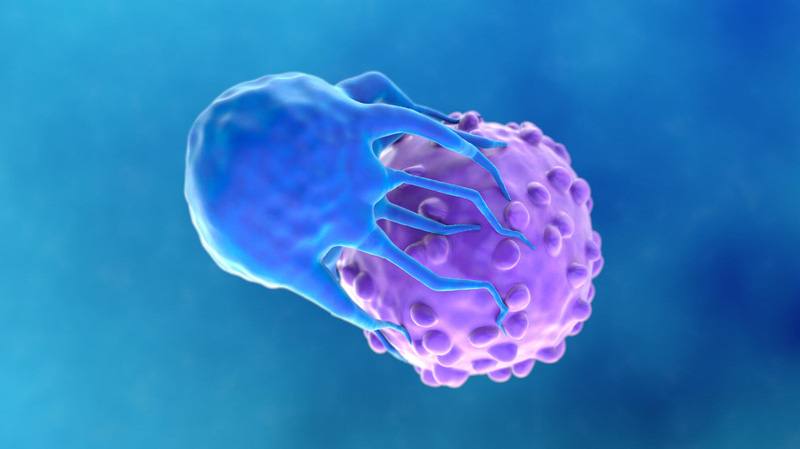
From early clinical trials to an established CAR-T Cell Therapy Program, Mayo Clinic has delivered the transformative therapy to over 1,500 patients.
A decade ago, chimeric antigen receptor-T cell therapy, or CAR-T cell therapy, was an experimental treatment only available through clinical trials. Today, Mayo Clinic offers CAR-T cell therapy at all three sites in Arizona, Florida and Minnesota and continues to explore new frontiers for the life-changing treatment.
That progress traces back to Mayo Clinic's early involvement in research exploring CAR-T cell therapy for patients with few remaining options.
In 2016, Mayo Clinic joined one of the first multicenter clinical trials evaluating CAR-T cell therapy for large B-cell lymphoma, an aggressive blood cancer. Most patients had stage 3 or 4 cancer. None had responded to other therapies.
CAR-T offered a way to fight their disease from within. Each participant's T cells — a type of white blood cell — were extracted, genetically reprogrammed to attack cancer cells and infused back into their body.
"We knew this could be a transformative treatment, and we wanted to apply Mayo's model of patient care from the beginning," says Dr. Yi Lin, Mayo Clinic's principal investigator for the trial and a hematologist in Rochester, Minnesota.
During the trial, researchers from 22 study centers collaborated in real time. "Every patient, every side effect, we were on a call together providing input," says Dr. Lin.
Over half of patients who received CAR-T cell therapy achieved complete remission, compared with 12% of patients who received conventional treatments available at the time.

"We knew this could be a transformative treatment, and we wanted to apply Mayo's model of care from the beginning." – Dr. Yi Lin
Dr. Lin later led the nation's first multicenter study of CAR-T for multiple myeloma, a type of blood cancer widely considered treatable but not curable. By the end of the study, 38% of patients were in remission.
These studies led to Food and Drug Administration (FDA) approval of CAR-T cell therapies for large B-cell lymphoma in 2017 and multiple myeloma in 2021.
They also signaled Mayo Clinic's important role in expanding access to CAR-T and translating its capabilities to other diseases. Mayo Clinic was among the first centers certified to provide CAR-T cell therapy in clinical practice and has administered it to over 1,500 patients.
"With so many top-ranked specialties, we can provide the best care during treatment without having to go outside of Mayo," says Dr. Lin, who also leads the Cell, Gene, and Virotherapy Disease Team at Mayo Clinic Comprehensive Cancer Center.
Learn how CAR-T cell therapy changed the course of care for some of Mayo Clinic's earliest recipients.
Journalists: Broadcast-quality video (1:34) is in the downloads at the end of this post. Please courtesy: "Mayo Clinic News Network." Read the script.
'I'm the oldest living CAR-T success story at Mayo Clinic'
John Renze was halfway home from the hospital after testing related to his migraines when his physician called. "I thought, 'Uh oh, there's something wrong here,'" he recalls. "He said there were tumors in my chest, close to my heart. He was scared for me."
John was referred to Mayo Clinic in Rochester, where he was diagnosed with stage 4 large B-cell lymphoma. Over the next two years, he tried chemotherapy, radiation and clinical studies. "Nothing got rid of it," says John. "I was running out of options."
Then, in 2016, he qualified for the seminal clinical trial evaluating CAR-T for large B-cell lymphoma. "I called it my last hope," says John.
His hope was realized beyond anything he thought possible. His first scan after the CAR-T infusion was completely clear.
"I went from piles of cancer to none in four weeks," he says.
This experience inspired Dr. Jonas Paludo, a Mayo Clinic hematologist, to specialize in cell therapy. Since then, he's witnessed many similar outcomes. Yet he still marvels at the success of his first CAR-T patient. At age 67, John remains in remission.
"He doesn't require any medications," says Dr. Paludo. "It's exciting seeing him back to his normal life — working full time, farming, enjoying life with his kids and grandkids."
'You've got to keep fighting'

Gina Ferreira, the first Mayo Clinic patient to receive the FDA-approved CAR-T therapy for lymphoma, is now cancer-free and enjoying life with her family. (From left to right: Pedro Ferreira, her husband; Gina Ferreira; Roman Ferreira, her son; Sierra Pazos, her daughter)
Gina Ferreira first noticed a lump on her chin while putting on her makeup. When an antibiotic didn't resolve it, a biopsy and PET scan revealed that Gina had large B-cell lymphoma.
"I had it from my neck to knees," she says. "It was everywhere. It was devastating because it seemed too far gone."
At 48 years old, with two kids in college, Gina was determined to fight. But after 29 rounds of chemotherapy, six weeks of radiation and a stem cell transplant, she began losing hope. Her husband, Pedro, scheduled a cross-country tour of cancer centers to explore CAR-T cell therapy.
"Once we got to Mayo Clinic, we had this feeling that everything was going to be good there," says Gina. "I said, 'This is the place.'"
In early 2018, Gina became the first Mayo Clinic patient to receive the FDA-approved CAR-T cell therapy for lymphoma. One month later, her first PET scan showed no evidence of cancer.
"It was unbelievable," she says.
Eight years later, Gina remains in remission.
"Mayo Clinic saved my mom's life," says her daughter, Sierra Pazos. "She was there when I became a doctor. She was there at my wedding. She was there when I gave birth to her grandson. She was there because of Mayo Clinic, and my family will be forever grateful."
The next frontier for CAR-T cell therapy
Mayo Clinic researchers continue to advance CAR-T cell therapy, exploring innovative delivery methods and the potential to treat diseases beyond blood cancers.
A new clinical trial led by Dr. Lin will modify T cells inside the patient's body instead of in a laboratory. This could eliminate the need for preinfusion chemotherapy and allow patients to be treated more quickly, since each therapy doesn't have to be manufactured individually. The phase 1 trial is enrolling patients with recurring multiple myeloma that hasn't responded to treatment.
Mayo Clinic is also leading CAR-T clinical trials for autoimmune conditions such as lupus and stiff person syndrome.
More information
Visit Mayo Clinic's CAR-T Cell Therapy Program website to learn more about treatment options, referrals and clinical trials.


