-
Research
Tomorrow’s Cure: 3D bioprinting living human skin to improve wound care, testing
Share this:





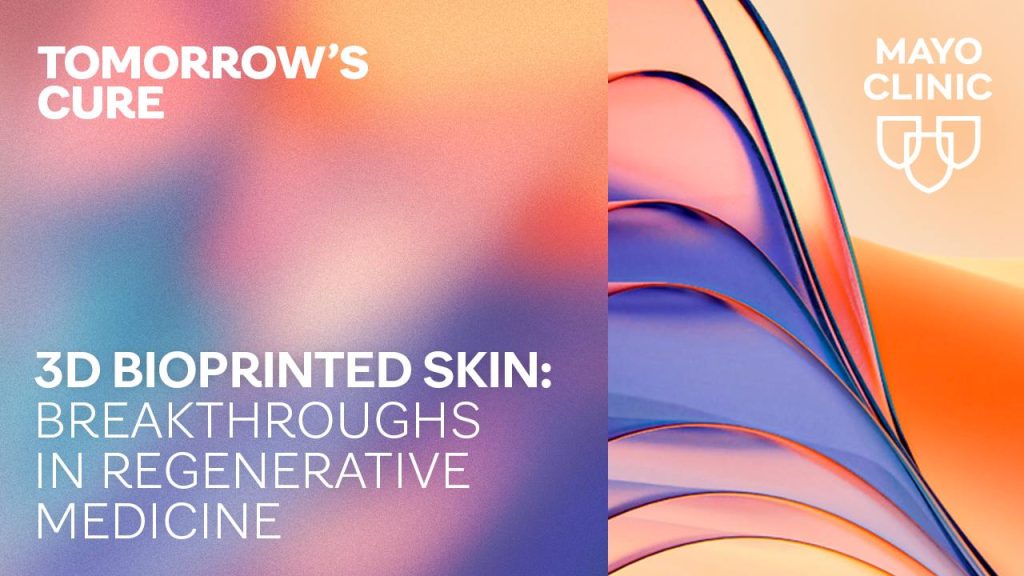
On this week's launch of the fourth season of "Tomorrow's Cure," the first episode features two pioneers at the intersection of biology and technology. Together, they explore a fast-moving frontier in regenerative medicine: 3D bioprinting living, humanized skin models built from real human cells and biologic building blocks.
The podcast episode features Saranya Wyles, M.D., Ph.D., a dermatologist at Mayo Clinic in Rochester, and Adam Feinberg, Ph.D., principal investigator of the Regenerative Biomaterials and Therapeutics Group at Carnegie Mellon University.
Dr. Wyles describes skin as a set of "cake layers," including the epidermis, dermis and hypodermis. She proposes that people think about skin span. "It's an idea derived from health span and life span. Our concept is that we can have optimally functioning skin at the level of structure but also at the level of its function, serving as a barrier preventing infection for longer," Dr. Wyles says. "The skin is a mirror to your systemic health."
A major goal is to model how skin changes over time because collagen and structure in younger skin can look very different from older skin. That's key for understanding healing, chronic wounds and how therapies may behave across ages and skin tones.
"We're using these advanced technologies to try to augment the body's ability to rebuild tissue structure," Dr. Feinberg says. He explains that collagen is the body's primary structural protein, so his lab focuses on bioprinting collagen in ways that mimic native tissue at microscopic scales. Using biologic materials rather than synthetic ones helps printed tissues behave more like the real thing and may improve how future implants integrate with the body.
Dr. Wyles highlights the team's work toward diagnostic and preclinical testing uses, with an emphasis on building an alternative to animal models. Printed skin can be observed as a living system, measured through its structure and secreted signals, then challenged with topical therapies to see how it responds.
Dr. Feinberg adds that moving away from animal testing is a growing priority, and engineered human tissue models may improve prediction because animal physiology differs from humans. The shared challenge is validation: proving that the models are reproducible and reliably predictive.
The episode also digs into senescent "zombie cells," which stop dividing but do not die. Dr. Wyles explains they can accumulate with age and in chronic wounds, releasing signals that influence the surrounding tissue. Her team studies patient samples to map these cells in conditions such as diabetic foot ulcers, then uses those learnings to build more realistic printed models, including patient-specific versions.
Both guests discuss how bioprinted skin for routine clinical use will take time. Progress depends on carefully defining the most urgent clinical problems, proving performance and scaling manufacturing. Potential future applications discussed include improved wound patches for burns, chronic wounds and tissue-loss injuries, along with better ways to test treatments before they ever reach patients.
Listen to the latest episode of "Tomorrow's Cure" wherever you get your podcasts. You can explore the full library of episodes and guests on the show's page.