Share this:





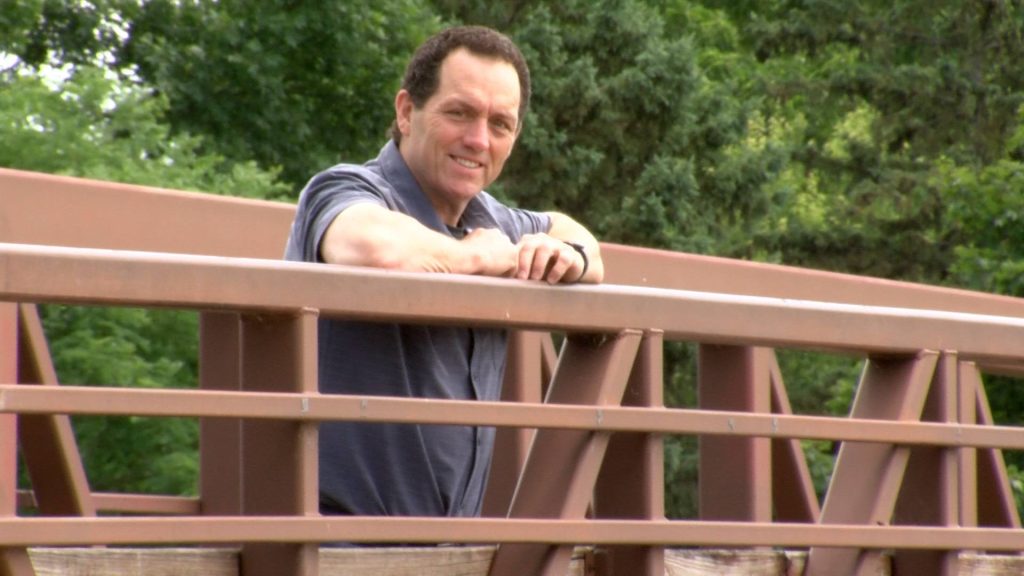
As the fire chief for the city of Fargo, North Dakota, Gary Lorenz is accustomed to high-stress emergencies.
"Firefighters are problem solvers," Gary explains. "When people call 911, and the dispatchers aren’t sure whom to send, they send the fire department."
But on Oct. 7, 2025, Gary faced a crisis he could not simply delegate.
During a routine scan for an unrelated issue, doctors discovered a tumor on his left kidney.
Stunned by the news, Gary recalls pacing the floor at his headquarters fire station, feeling overwhelmed and not knowing what to do next.
"I am kind of a fixer," says Gary. "Whether it's mechanical or other things, I'm fixing problems all the time, and so when it was my problem, trying to figure out how to fix this, it just seemed big."
Walking in circles, the reality of his diagnosis set in.
With the love and support of his wife, who works in the medical field, Gary discussed the next steps and knew exactly where to turn. He reached out to Mayo Clinic.
Watch: Robotic surgery helps fire chief return to duty
Journalists: Broadcast-quality video (3:01) is in the downloads at the end of this post. Please courtesy: "Mayo Clinic News Network." Read the script.
A rapid response and a precise plan
Within one day, a video conference was scheduled for the following week with Dr. Aaron Potretzke, a Mayo Clinic urologic surgeon.
Knowing a plan was in place, his family urged him to go ahead with his annual fishing trip that weekend to Lake of the Woods in Canada.
While driving, Gary received a call from Mayo Clinic asking whether he could meet virtually that Friday instead of the following week.
During the videoconference, Dr. Potretzke explained how the scans described a single, approximately 4-centimeter bi-lobed tumor, but the exact nature of the growth would not be determined until after it was surgically removed.
Because of the tumor's location and associated risks, Dr. Potretzke recommended a robotic-assisted radical complete nephrectomy, a minimally invasive surgery using robotic tools to completely remove a kidney through tiny incisions.
"Dr. Potretzke’s thoroughness, professionalism and confidence greatly helped relieve much of the anxiety I was experiencing," says Gary.
In short order, Gary received a call on Monday morning from Dr. Potretzke’s office about a last-minute surgical opening for the next day.
Mayo staff coordinated and communicated with Gary to complete all of the necessary surgical preauthorization.
Despite this tight timeline and a five-hour drive the night before, he was in the operating room exactly one week after his diagnosis.
"It’s unheard of to go from start to finish that quickly," Gary says. "It felt like people actually cared how fast it came together."
Dr. Potretzke says Gary's case was unique because of the multidisciplinary coordination that occurred in such a short time while Gary was several hours from Rochester, Minnesota.
"To be able to get him into the operating room that fast was not something that we see every day, but it shows that this system works really well — and people at Mayo Clinic go the extra mile in an amazing way to take great care of patients in a thorough and efficient way," says Dr. Potretzke.
Because of this advanced approach, he spent just a single night in the hospital and was able to return to work four days later.
Dr. Potretzke will continue to monitor Gary over the next two years for signs of recurrence.
Reaching a milestone: 100,000 da Vinci robot-assisted surgeries
Gary's successful journey comes as Mayo Clinic marks a milestone in robotic-assisted surgery. This summer, Mayo Clinic surpassed 100,000 surgeries assisted by the da Vinci robot.
Mayo Clinic uses advanced surgical robots to perform complex operations with precision, helping patients like Gary experience less pain, spend less time in the hospital and recover faster.
"At Mayo Clinic in Arizona specifically, it's a marker of how far we've come as a campus from adopting the technology to now defining where complex robotic surgery goes next," says Dr. Michelle Nguyen, a Mayo Clinic transplant surgeon. "Reaching 100,000 cases is a meaningful milestone, but it's the culture of innovation behind it that will define what the next 100,000 look like."
Much of that progress is being driven by breakthroughs in surgical technology.
"Robotic-assisted surgery allows us to perform increasingly complex operations with greater precision, control and safety," says Dr. David Yang, a urologist at Mayo Clinic Health System in Mankato, Minnesota. "This translates into improved patient outcomes, less postoperative pain and faster recovery. Perhaps just as importantly, procedures that were once only available at large tertiary care centers can now be performed closer to home."
That high level of care is a collective effort.
"Each of those 100,000 robotic surgeries was made possible by our exceptional care teams, including not only surgeons at Mayo Clinic in Florida but nursing teams, anesthesia, surgical staff, custodial support, scheduling and many others," says Dr. Mara Piltin, a Mayo Clinic surgical oncologist. "Each member of our institution plays a meaningful role in allowing us to offer high-volume, high-complexity care to patients in need, and we are grateful for each piece of the puzzle."
Grateful for the seamless multidisciplinary care
Reflecting on his clear follow-up scans and rapid recovery, Gary is grateful for the seamless multidisciplinary care he received.
Highlighting how technology empowers clinical teams, Dr. Potretzke notes that robotic-assisted surgery has been a tremendous asset.
"Robotic surgery allows us to enhance traditional laparoscopy with 3D and magnified visualization, and articulating instruments that allow for meticulous dissection and sewing in very small spaces," he adds.
Meanwhile, patients like Gary are thankful for the team at Mayo Clinic.
"I told Dr. Potretzke I would only share my story if I could brag about him and his team," says Gary. "You really respect the knowledge and training that the care team has."
Related Articles