Share this:





More than 200,000 joint replacement patients have helped Mayo Clinic personalize care, improve outcomes and shape the next generation of treatment.

For nearly six years, Bob Morreale has lived with a shoulder replacement. Most days, he does not think about it at all.
That, he says, is the point.
For Bob, 56, of Rochester, Minnesota, the road to shoulder replacement began decades earlier. A former Division III college baseball pitcher, he sustained shoulder injuries that led to instability, tissue damage, previous surgeries, and eventually, osteoarthritis. Over time, pain became part of daily life.
“Turning a doorknob, holding a coffee cup, sleeping on my right side, and throwing became difficult,” Bob says. “It didn’t completely stop me from doing things, but I was constantly making adjustments.”
Bob knew he needed a more permanent solution to manage his pain. At Mayo Clinic in Rochester, he met with Joaquin Sanchez Sotelo, M.D., Ph.D., an orthopedic surgeon, to discuss whether total shoulder replacement could be an option.
Like many patients considering joint replacement, Bob wanted to know how long an implant might last and whether he could expect to regain comfortable motion. Dr. Sanchez Sotelo could answer those questions with confidence, drawing on decades of outcomes data from thousands of joint replacement patients treated at Mayo Clinic.
How decades of patient follow-up help guide your care
That confidence comes from more than 50 years of systematically tracking patient-reported outcomes. Since performing the first FDA-approved total hip replacement in the United States in 1969, Mayo Clinic has followed joint replacement patients throughout their lives, creating one of the world's largest collections of long-term outcomes data.
"After surgery, we connect with patients on a regular basis. Even after a surgeon retires, another will step in and continue to check in with patients throughout the remainder of their life," says Matthew Abdel, M.D., chair of the Surgical and Procedural Practice at Mayo Clinic.
For patients like Bob, that depth of follow-up matters. It allows surgeons to have more informed and honest conversations about what patients can expect — including pain relief, function, durability and whether another surgery may be needed in the future.
Making an informed decision
After discussing the benefits, risks and alternatives with his surgeon, Bob decided to move forward with an anatomic total shoulder replacement. Based on his age, anatomy and overall shoulder condition, the procedure offered the best opportunity to relieve pain, restore function and return to the activities he enjoyed.
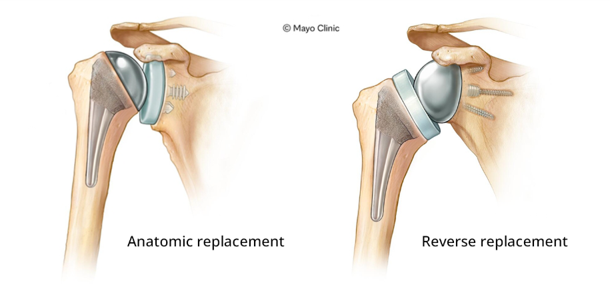
Recovery from surgery required patience. Bob spent weeks in a sling and worked through physical therapy to rebuild strength and motion. But as movement returned, so did the ordinary parts of life he had been missing.
"The results have been remarkable," Bob says. "I have no pain, full range of motion, and can do everything I want to do. My sons are now adults, but I can still play catch with them!"
How every patient helps improve joint replacement
Every patient who participates in follow-up contributes to a deeper understanding of long-term outcomes, helping Mayo Clinic refine care and better guide future patients.
For patients, that means care informed by decades of real-world outcomes, helping surgeons provide clearer expectations about recovery, function and long-term results.
Like more than 200,000 joint replacement patients treated at Mayo Clinic, Bob continues to participate in periodic follow-up after surgery.
Nearly six years later, he rarely thinks about his shoulder anymore.
That's exactly what he hoped for.
Related Articles


