-
Education
Shaped by curiosity, supported by Education: How Mayo Clinic propelled Dr. David Sanborn’s career in transplant medicine
Share this:






From the moment David Sanborn, M.D., arrived at Mayo Clinic as a resident in 2018, he envisioned a career built around caring for the whole patient. What he did not anticipate was how fully Mayo's education programs, mentorship culture and research capabilities would shape his training — and launch his career as a clinician‑scientist in lung transplantation.
Dr. Sanborn completed all of his graduate medical training at Mayo Clinic School of Graduate Medical Education, including internal medicine residency, a chief resident year, pulmonary and critical care fellowship, and a highly specialized transplant‑focused fellowship. Along the way, Mayo's educational flexibility allowed him to explore his interests before narrowing his focus.
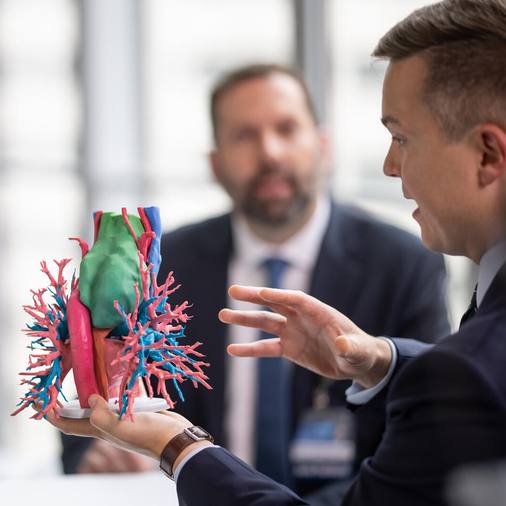
"I wanted deeper expertise," he says, "but I never wanted to give up taking care of the whole patient."
That philosophy ultimately drew him to lung transplantation, where he could care for patients over many years, not just during moments of crisis, and see how treatment decisions shaped their quality of life. The specialty offered what he was seeking from the beginning: ongoing relationships with patients and families, complex medicine, and the chance to help people reclaim milestones they once thought were out of reach.
Training future colleagues to advance the science of transplantation
Dr. Sanborn's training coincided with a period of rapid program growth. Over the past several years, the number of lung transplants performed at Mayo Clinic in Rochester, Minnesota, has increased, highlighting a national shortage of physicians prepared to manage the complex, long-term needs of these patients. In response, Mayo launched the Advanced Lung Disease and Lung Transplant Fellowship in 2023.
"In planning for that growth, it became clear that we needed not only more staff, but better training pathways," says Cassie Kennedy, M.D., Dr. Sanborn's research mentor and medical director of Lung Transplantation at Mayo Clinic in Rochester. "There are very few programs in the U.S. preparing physicians to care for lung transplant patients at this level. One of our goals was to train future colleagues who excel clinically, are committed educators, and are motivated to advance the science of transplantation. Dr. Sanborn is a clear example of that vision in practice."
A defining feature of his fellowship was protected research time and faculty mentorship. Supported by Dr. Kennedy and fellowship director Kelly Pennington, M.D., a Mayo Clinic transplant pulmonologist and critical care specialist, Dr. Sanborn devoted a full year of research to studying chronic lung transplant rejection, an area that historically lacked predictive tools.
His work adapts Mayo‑developed CALIPER imaging technology and applies machine‑learning approaches to identify early, noninvasive changes associated with rejection.
"Dr. Sanborn brings a level of curiosity and drive that elevates the entire team," says Dr. Pennington. "He consistently turns clinical questions into meaningful research. His success reflects both his dedication and an environment that encourages innovation and mentorship."
As the project expanded, Dr. Sanborn recognized the need for formal research training. "I knew I needed stronger grounding in statistics and study design if I wanted to do this well," he says.
With faculty advocacy, Mayo provided fully funded tuition and protected time for him to pursue a master's degree in clinical and translational science through Mayo Clinic Graduate School of Biomedical Sciences during his fellowship. The program connected him with statisticians, ethicists and clinical trial experts who became long-term collaborators. He will complete the degree in June, the same month he finishes his fellowship.
Helping trainees build meaningful careers
Mentorship remains central to Dr. Sanborn's work. A former chief resident, he actively mentors residents and fellows and recently began mentoring a Mayo Clinic Alix School of Medicine student developing a transplant‑related research project. He sees teaching as essential to sustaining academic medicine and helping trainees build meaningful careers.
That pipeline extends to MCASOM students at all three campuses (Rochester, Arizona and Florida) through elective transplant rotations, which immerse learners in the full transplant journey. Students observe liver, kidney and pancreas transplant surgeries, participate in organ recovery, join transplant rounds, and engage in post‑transplant inpatient care. They also attend transplant selection and education conferences, gaining insight from evaluation through recovery.
In July, Dr. Sanborn will join the Mayo Clinic staff as a transplant pulmonologist, continuing both his clinical work and research with dedicated time.
"Mayo didn't just train me," he says. "They invested in what I wanted my career to look like, and now I get to stay, care for patients and help move the field forward. That means everything to me."