-
Featured News
Mayo Clinic food donations nourish local community
Share this:





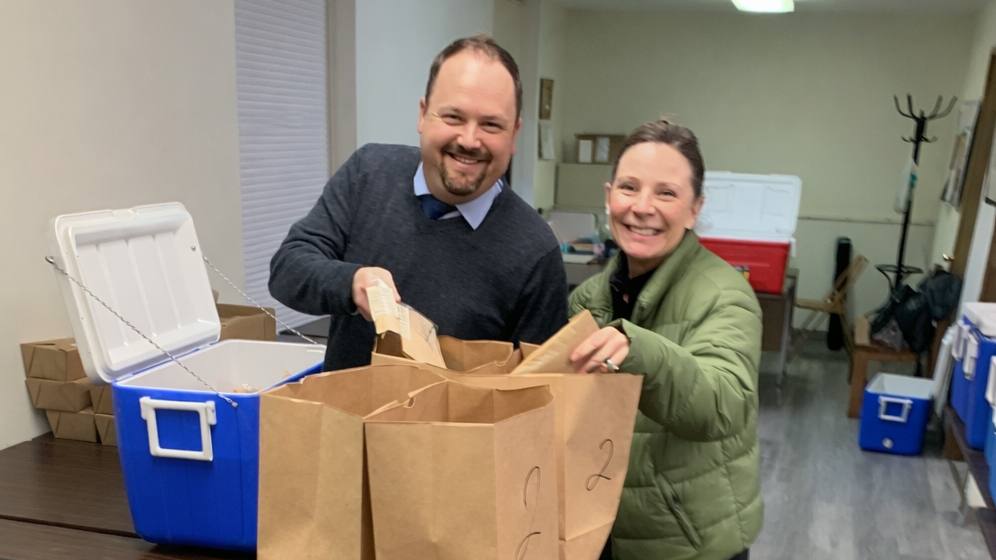
Each year, Mayo Clinic donates over 53,000 pounds of food to Community Food Response in Rochester, Minnesota, reducing waste and supporting local people in need.
Three days a week, Community Food Response volunteers fill paper bags with food retrieved from all over Rochester, Minnesota. By 3:30 p.m., cars stretch down the city block. Some people arrive on foot, often from nearby homeless shelters.
Each bag contains enough food for three meals for three people. Typically, at least one item — a salad, a sandwich, a bottle of milk — is from Mayo Clinic.
"We want to get food to people in need rather than into the waste stream," says Aaron Clark, manager of Food Service Operations at Mayo Clinic in Rochester. "This is our way to extend Mayo values into the community."
His team uses forecasting tools to anticipate Mayo Clinic's food needs and reduce waste. Still, some surplus is inevitable. Community Food Response simplifies sharing it with neighbors.
On distribution days, drivers pick up prepared, fresh and frozen foods from nearly two dozen local places — restaurants, supermarkets, hospitals, caterers. Last year, Mayo contributed over 53,000 pounds of food to the organization.
A recent Mayo Community Contributions grant also helped Community Food Response purchase new freezers, coolers, food packaging and other necessities, ensuring the collaboration can continue.
Bringing healing through meals
Community Food Response began in 1993 after a Mayo physician and Rochester restauranteur asked, "What happens to the city's leftovers?" Their curiosity led to a grassroots effort that now feeds hundreds of people in the local community.
By some estimates, 1 in 5 Minnesota households struggle with food access. In 2025, food security was named a priority area in Olmsted County's Community Health Needs Assessment for the first time.
From logistical to financial, "there are many reasons for food insecurity," says Chris Tatting, board president for Community Food Response and a hospital operations manager at Mayo Clinic in Rochester. "Whether someone is food insecure for several years or one week, we can help."
For Mayo Clinic, this offers an opportunity to meet an everyday need while supporting long-term health. "The best healthcare we can provide is preventing diseases if possible. Nutrition plays a big role in that," says Dr. Sara Bonnes, medical director for Food and Nutrition Services at Mayo Clinic. "This isn't just about access to food — it's about access to nourishing food."
Every Monday, Wednesday and Friday, Community Food Response volunteers, some of whom are Mayo staff members, have the privilege of providing that.
On a recent weeknight, a woman in the food line shared that she was fleeing domestic violence. Due to her health, she could only eat liquids, so the team packed up nutritious drinks, soups, yogurts and juices.
"She cried. I cried," a Community Food Response coordinator posted on the nonprofit's Facebook page. "This is what we do for our community."
From surplus to sustenance
To find a home for every type of food, Mayo Clinic in Rochester also collaborates with Ronald McDonald House in Rochester, offering Mayo meals to families of hospitalized children. Across the enterprise, other food rescue efforts minimize waste while helping people in need:
- Mayo Clinic in Florida supports Meals on Wings, which repurposes unused hospital food to provide meals for Jacksonville seniors, and Feeding Northeast Florida, a local food bank that rescues food and distributes it to hundreds of other organizations.
- Mayo Clinic in Arizona recently awarded a Community Contributions grant to the Society of St. Vincent de Paul, which includes a food pantry network, a kitchen that makes 7,000 meals a day and a food reclamation center that rescues millions of pounds of food annually.
- Mayo Clinic Health System donations and volunteers support local food shelves and organizations, such as Community Table, ECHO Food Shelf, Feed My People Food Bank and The Salvation Army.
Through these collaborations, surplus becomes sustenance. Stewardship becomes service. And Mayo Clinic helps meet an essential need within local communities.