-
Orthopedics/Sports
Mayo Clinic Q&A: How is hip impingement affecting young adults?
Share this:






DEAR MAYO CLINIC: My nephew is in his 20s and has been complaining about ongoing hip pain, especially after working out. When it didn’t improve, he saw an orthopedic specialist and was diagnosed with hip impingement. What is that?
ANSWER: Hip impingement, also called femoroacetabular impingement, is a condition that often affects young, active adults. It occurs when the shape of the hip joint causes the ball and socket to pinch during movement. Over time, that can lead to pain, stiffness and wear in the joint.
Hip impingement exists on a spectrum. Some people have changes in the shape of the hip and never develop symptoms. Others develop pain that begins to affect exercise, work or everyday activities.
The hip is a ball-and-socket joint. In some people, the socket may develop differently, or extra bone may form where the ball and neck of the femur meet. That extra bone on the femur is often called a cam lesion. These shape changes can cause the bones to come into contact earlier than they should during movement, especially when the hip is bent deeply during sitting, squatting or sports. This can lead to pain and reduced range of motion.
Hip impingement is much more recognized today. The condition became better understood in the early 2000s, when specialists began linking some cases of hip pain and early arthritis to structural differences in the hip joint. Young adults also may be active longer, which can make symptoms more noticeable. However, not everyone with hip impingement has symptoms.
The most common symptom is groin pain. Some people also describe pain that wraps around the side of the hip in a C-shaped pattern. Symptoms often become worse with prolonged sitting, long car rides or activities that involve deep hip flexion, such as deep squats or stepping onto a high surface.
Occasional pain that goes away may not need immediate evaluation. However, you should seek medical care if hip pain persists for weeks or months, begins to affect daily life, or prevents participation in activities you enjoy.
Sports and activities that involve deep hip bending, agility and pivoting can make symptoms more likely. This includes hockey, rowing, soccer, hurdles and some forms of dance, especially ballet.
Typically, hip impingement isn't something people are born with; the shape of the hip develops over time. The socket reaches its final shape relatively early in life. Changes on the femur side of the joint, including cam lesions, are thought to develop during adolescence, especially in active teens.
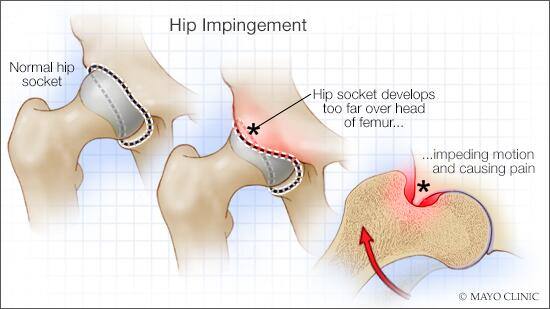
Diagnosis often starts with the symptoms a person describes. Groin pain, pain with sitting, and a pinching sensation during activity can all point toward hip impingement. A physical exam also is important, since many people have reduced motion when the knee is brought up toward the chest. X-rays help evaluate the shape of the hip. In some cases, an MRI is used to examine the cushioning cartilage, such as the labrum, more closely, especially if surgery is being considered.
The first line of treatment often is physical therapy to strengthen the core, lower back and muscles around the hip. Activity changes and anti-inflammatory medications also may help. It’s important that therapy specifically targets hip impingement, since some exercises may worsen symptoms.
If symptoms continue and begin to affect quality of life, surgery may be considered. The most common procedure is hip arthroscopy, which uses small instruments and a camera to repair the labrum and reshape areas of bone. Recovery takes time, with crutches often needed for four to six weeks, followed by a gradual return to activity. Most people improve within three to four months, although returning to higher-level sports may take closer to six months.
If left untreated, outcomes for hip impingement depend on the severity of the condition. In some people, it may raise the risk of arthritis later in life. In others, symptoms may stay mild or manageable. Not every person with hip impingement will need surgery, and treatment decisions should be based on symptoms and how much the condition affects daily life.
Hip impingement can be an overlooked cause of ongoing hip pain in young adults, especially in people who are active. It’s often manageable with the right treatment and activity changes. If hip pain keeps coming back or begins to interfere with daily life, it’s worth getting checked rather than assuming it’s just a strain.
Mason Uvodich, M.D., Orthopedics & Orthopedic Surgery, Mayo Clinic Health System, La Crosse and Onalaska, Wisconsin