Share this:





With youth mental health challenges on the rise, Mayo Clinic supports programs that help build confidence and resilience among young people.
In 2021, the surgeon general warned of an emerging national youth mental health crisis. Yet, even as awareness grows, 1 in 5 adolescents report a lack of mental health support.
"Mental health drives quality of life. It's also associated with your risk of chronic diseases, like heart disease," says Dr. Brian Lynch, a pediatrician at Mayo Clinic in Rochester, Minnesota. "Mental health during adolescence predicts mental health as an adult, so it's a critical time to intervene."
The challenges affecting Mayo Clinic communities reflect nationwide trends.
Mental health was identified as a key priority in the most recent Community Health Needs Assessments for Mayo Clinic in Florida, Mayo Clinic in Rochester and many Mayo Clinic Health System sites.
Among young people, girls are experiencing especially high rates of anxiety, depression and suicidal thoughts — nearly twice the rate of boys.
"The stressors of peers, family expectations, social media — these seem to be affecting girls differently," says Dr. Lynch, the Community Health Needs Assessment physician director for Olmsted County, Minnesota, which includes Rochester. "It's a major concern."
Through community grants and volunteer efforts, Mayo Clinic supports two organizations that help girls build confidence, coping skills and resilience.
Pace Center for Girls in Florida
When girls arrive at the Pace Center for Girls, they're often struggling academically, socially, emotionally — or all three. At each of the center's 16 Florida locations, the Reach Program provides no-cost counseling wherever girls feel most comfortable, whether at home, the library or a local park.
"We believe all girls, regardless of their story, deserve safe, supportive spaces to heal and help them become strong, compassionate and successful women," says Erica Wortherly, the Reach Program director.
Many of the girls, ages 11–17, have experienced life-altering challenges, such as sexual abuse, trafficking and homelessness. Some have a parent who is incarcerated or absent due to substance use. Nearly all wouldn't have access to mental health care without Pace.
Given these complex needs, counseling alone isn't always enough. A 2026 Mayo Clinic Community Contributions grant has enabled Pace to offer psychiatric services — diagnosis, medication management, follow-up visits — at no cost to girls who need it.
Psychiatric services are also available to participants in Pace's Day Program, which provides academic and mental health services in a classroom setting.
With Mayo's assistance, "we're helping girls get to know themselves and receive the loving support they need to build relationships, develop healthy coping skills and look toward the future," says Wortherly. "Psychiatric services give that additional level of support."
Another recent Mayo Clinic grant provided books for the Jacksonville, Florida, center's library, which opened earlier this year and will host a book club for girls in Pace programs.
Girls on the Run in Minnesota
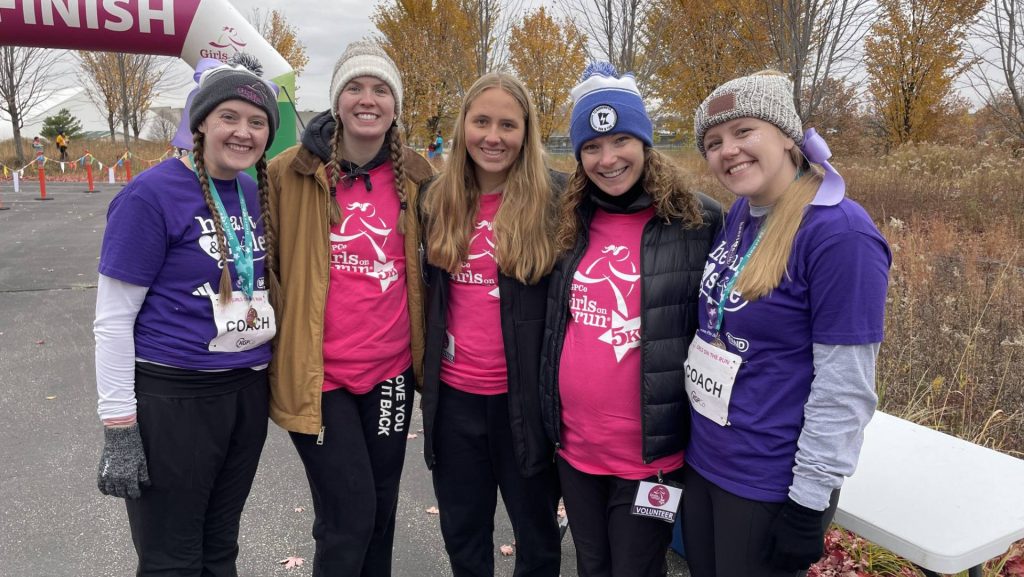
Every fall and spring, hundreds of girls gather near Mayo Clinic in Rochester for the Girls on the Run 5K. But before they start running or walking, they need "happy hair."
"The girls use all those fun hairsprays — pink, red, blue — to color their hair," says Amanda Neve, a pediatric nurse supervisor at Mayo Clinic in Rochester and coach for Heart & Sole, the Girls on the Run program for middle schoolers. "A lot of times, they make their running buddy do it too."
The result? Dads with neon beards and moms with rainbow hair running alongside their girls.
This nontimed event caps off the Girls on the Run season, which combines physical activity with social-emotional learning for girls in grades 3–8. In addition to the Rochester race, 5Ks are held in the Twin Cities and Duluth, Minnesota.
This year, a Mayo Clinic Community Contributions grant provided scholarships for the after-school program, giving more girls the opportunity to learn about boundary-setting, relationships and emotional regulation while forming new friendships.
"At first, they're often hesitant to talk," says Neve. "By the end of the season, they open up a lot more and have the skills to handle scenarios in real life."
The race reinforces this confidence in a tangible way.
Kristi Pogatchnik, the development director for the Girls on the Run Minnesota council, recalls one girl who exclaimed, "I'm a doer!" at the end of the event. When her dad asked why, she explained that she'd always thought of herself as a watcher. Now, she knew that wasn't true.
This inner shift exemplifies the Girls on the Run mission.
"When they cross that finish line, it's like, 'Wow, I just did that. What else can I do?'" says Pogatchnik. "It takes a whole community to support girls in this way. We're so grateful for all that Mayo does."
Related Articles