-
Surgery
‘Thank you feels inadequate:’ Finding hope at Mayo Clinic
Share this:





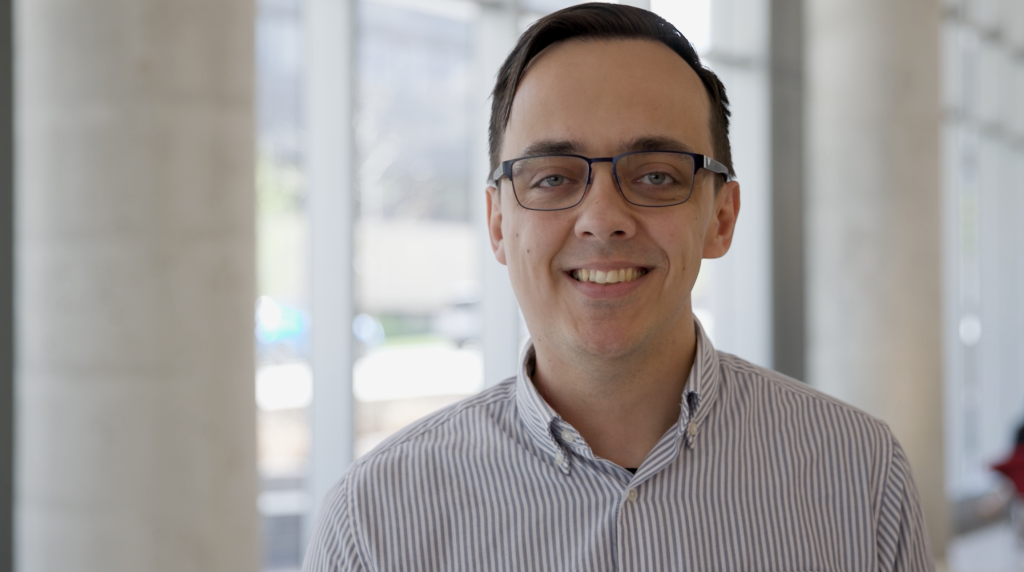
By the time Dr. Jamie Kane arrived at Mayo Clinic in 2024, he had largely stopped believing his condition could be cured.
For nearly a decade, Jamie had lived with a head and neck arteriovenous malformation (AVM), enduring repeated procedures, chronic pain and growing risks to his heart.
"I had kind of settled into thinking, 'OK, this is just a lifelong condition,'" says Jamie.
A diagnosis that changed everything
Jamie's symptoms appeared in 2015 during his first year at the University of Manchester in England. What initially seemed like mild swelling on the right side of his neck eventually led to the diagnosis of an AVM, a condition in which arteries connect directly to veins, bypassing the body's normal capillary network.
Over the following years, Jamie underwent multiple embolization procedures that temporarily slowed the AVM but failed to stop its progression. The pain intensified, and the malformation continued to grow.
Specialists at international medical centers had determined that the surgery required to remove his AVM was too dangerous.
Jamie recalled that one surgeon told him, "The risks for surgery are too great. There is a 50% chance that you will be dead."
An unexpected opportunity
In 2024, Jamie moved to Rochester, Minnesota, to begin a postdoctoral research position at Mayo Clinic. After settling into his new role, Jamie decided to seek one more medical opinion.

"I did have it in the back of my head that Mayo might be able to do what others were not able to do," says Jamie.
He was evaluated at Mayo Clinic's Vascular Anomalies Clinic, where physicians quickly recognized the severity of Jamie's condition.
"When I first met Jamie, my main concern was the fact that the AVM was so high flow that it was causing a significant impact on his heart," says Dr. Waleed Brinjikji, an interventional radiologist at Mayo Clinic in Rochester. "This was not just a cosmetic concern but was causing some real physiological compromise."
Further evaluation from Dr. Ruben Crespo-Diaz, a cardiologist at Mayo Clinic in Rochester, revealed that Jamie was developing high-output heart failure because of the AVM, meaning that his heart could not keep up with the high flow of blood.
"The progression of heart failure was inevitable," says Dr. Waleed Gibreel, a plastic and craniofacial surgeon at Mayo Clinic in Rochester, who would eventually lead the surgery.
Preparing for a high-risk operation
The first step was to assemble a team that could study Jamie's case and present him with a treatment option. Dr. Gibreel called on colleagues from Neurosurgery, Otolaryngology (ENT), Vascular Surgery and Anesthesiology.
Once the team was identified, in the months leading up to the surgery, Dr. Brinjikji performed a series of embolization procedures to reduce blood flow through the AVM and increase the likelihood of surgical success.
"The embolization procedures were intended to slow blood flow by 90% to simplify the operation as much as possible so that Dr. Gibreel and the team could perform the surgery safely," says Dr. Brinjikji.
For the surgical team, preparation involved constant collaboration across specialties, from reviewing scans together and mapping altered anatomy to coordinating every phase of the operation.
However, even with the extensive preparation, the stakes were extraordinarily high.
"Any surgical treatment option in this situation comes with a risk of potentially uncontrollable bleeding, so the hesitation other centers had was understandable," says Dr. Gibreel. "Cases like Jamie's require an entire multidisciplinary team prepared to take on exceptionally complex problems, and that's what Mayo Clinic is uniquely positioned to do."

A surgery made possible by a dedicated team
In February 2025, Jamie underwent the operation that many believed could not be performed.
Teams worked simultaneously throughout the nearly 12-hour surgery to remove the AVM from Jamie's neck and skull base while reconstructing critical tissue and blood vessels affected by the malformation.
"As part of the reconstruction, we took tissue from Jamie's thigh and created new blood vessel connections in his neck," says Dr. Gibreel.
To fully remove the AVM, surgeons also had to sever nerves controlling certain movements in Jamie's shoulder. During reconstruction, the team performed a nerve transfer — reconnecting nearby nerves to help preserve shoulder function.
Jamie spent several days recovering in the intensive care unit as his care team monitored closely for complications that they had spent months preparing to prevent.
Despite the complexity of the procedure, Jamie's recovery progressed better than anticipated.
'It was gone.'
Months later, Jamie returned for a follow-up angiogram.
The team expected the imaging would likely show some residual signs of the AVM. Instead, the scan revealed something extraordinary.
"It was gone," says Dr. Brinjikji. "The angiogram looked completely normal. You would have never guessed there was anything there."
Additional imaging confirmed the AVM was completely gone, and Jamie's heart function had returned to normal.
"What I saw was the impossible becoming possible," says Dr. Brinjikji.
For Dr. Gibreel, caring for Jamie also reflects what becomes possible when a multidisciplinary team unites around a shared purpose.
"Every single person's effort counts," says Dr. Gibreel. "This was not about the skill set of one person or the surgeons in the operating room. It was every single person — the nurses, anesthesia team, the ICU staff — who saw a common goal at the end, to give Jamie a second chance at life."
Today, Jamie is pain-free and continuing his postdoctoral research at Mayo Clinic — something that he once thought might not be possible. "I don't really know how to express my gratitude," says Jamie. "Thank you feels inadequate."
Watch: Multidisciplinary care teams at Mayo accompany Jamie on his medical journey.