-
Research
Mayo Clinic summit explores the next phase of healthcare AI (VIDEO)
Share this:





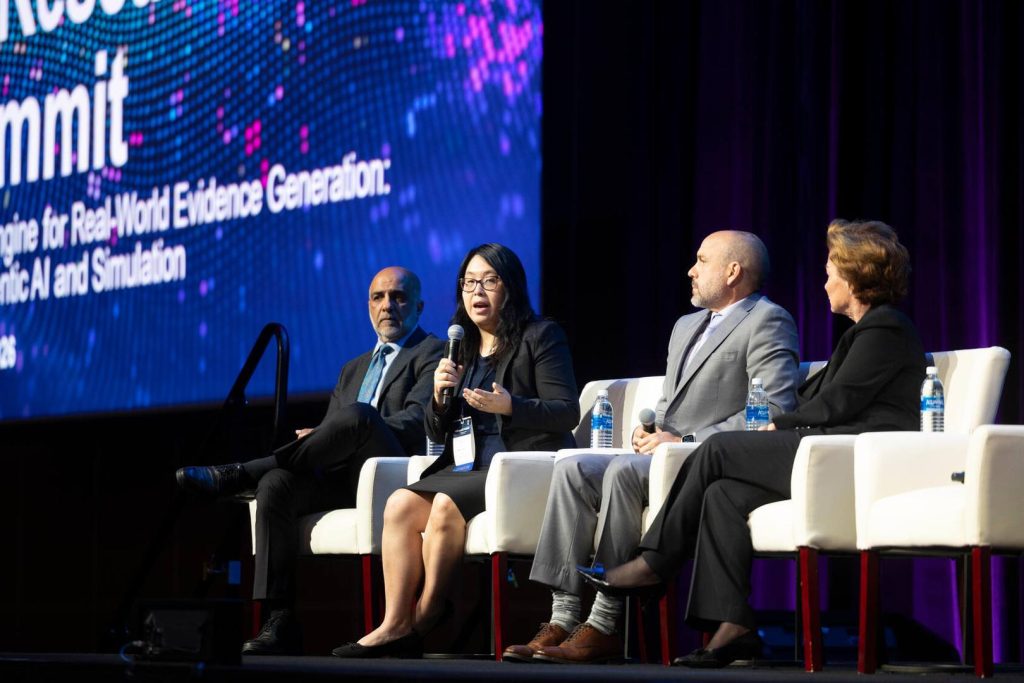
Healthcare AI is evolving beyond predicting outcomes to helping clinicians and researchers make informed decisions.
This shift was a key focus of Mayo Clinic's AI Research Summit, where more than 750 researchers, clinicians, AI scientists, engineers, students and other innovators gathered June 4–5 in Rochester, Minnesota, and online.
"The future of healthcare AI is not simply about building better predictor models, it's about developing integrated decision intelligence systems," said Cui Tao, Ph.D., the Nancy Peretsman and Robert Scully Chair of AI and Informatics at Mayo Clinic.
The summit highlighted emerging approaches such as multi-agentic AI, in which multiple agents work together on complex tasks, and simulations that use real-world data to test ideas and generate insights faster.
Helping personalize patient care
A key application of healthcare AI is personalized decision support at the point of care.
Yong Chen, Ph.D., of the University of Pennsylvania, said clinicians need tools that go beyond prediction to help them determine which actions will lead to the best patient outcomes.
Healthcare is a sequence of interconnected decisions that evolve over time — which treatment to use, when to intervene and when to adjust care. Integrated AI tools could help care teams determine the optimal next step for each patient.
For example, when patients receive an implant such as a stent, personalized decision-making support systems could help clinicians determine the best timing for antiplatelet therapy while reducing the risk of complications.
Changing how discoveries are tested
AI and automation may help researchers accelerate the discovery and testing of new medical treatments, said Matt Redlon, chair of the AI Program and vice president of Digital Biology, Mayo Clinic Digital Pathology.
For many diseases, thousands of existing drugs could be studied for potential repurposing, said Redlon.
Multi-agentic AI systems could be used to simultaneously analyze data from multiple sources such as biospecimens and clinical records, helping researchers identify the most promising treatments for further study.
Researchers also are exploring virtual trials, which use AI and existing healthcare data to simulate clinical trials, as a strategy to generate early signals from real-world data. This could substantially shorten the timeline for assessing promising new therapies for patients.
Watch: Mayo Clinic summit highlights shift in healthcare AI research
Journalists: Broadcast-quality sound bites are available in the downloads at the bottom of the posts. Name super/CG: Cui Tao, Ph.D./Nancy Peretsman and Robert Scully Chair of AI and Informatics at Mayo Clinic/Mayo Clinic/Matt Redlon/Chair of AI Program, Vice President of Digital Biology in Digital Pathology/Mayo Clinic/Micky Tripathi, Ph.D./Chief AI Implementation Officer/Mayo Clinic
Supporting clinicians and researchers
In addition to delivering more personalized care, AI technologies are being developed to streamline work for healthcare staff.
Some solutions are designed to augment human capabilities by "doing things that humans literally can't do with the limitations of our senses," said Micky Tripathi, Ph.D., chief AI implementation officer at Mayo Clinic.
For example, researchers have developed AI models that can help clinicians detect pancreatic cancer early from routine abdominal scans before tumors are visible.
Building the foundation for responsible AI
Peter Lee, Ph.D., president of Microsoft Science, emphasized that AI in healthcare has rapidly moved from idea to infrastructure, with solutions such as ambient tools that capture data in patient care now widely used.
As these capabilities expand, healthcare organizations must build the governance, oversight and supporting infrastructure needed to deploy technologies safely, responsibly and reliably.
Tripathi compared this to building a car. "You defined an engine; that's great. But it doesn't have a chassis, doesn't have a steering wheel, doesn't have windshield wipers, it doesn't have lights," he said. "We need all of those things."
Speakers emphasized that human oversight remains essential, with clinicians and researchers responsible for evaluating information and making final decisions.
"The momentum is clearly growing," Dr. Tao said. "If AI is going to become a part of real clinical care, we need rigorous validation, a governance framework, workflow integration and translational maintenance. And that translation from innovation to responsible implementation is exactly where the field is heading next."
Other experts, including Yi Qian, vice president of Global Real World Evidence at Johnson & Johnson, highlighted approaches to creating trusted evidence and insights for clinical care.
Related
- Mayo Clinic and Microsoft collaborate to develop a frontier AI model for healthcare
- How researchers are using AI to accelerate the path to cures (VIDEO)
- How 60 years of health data helped shape modern medicine